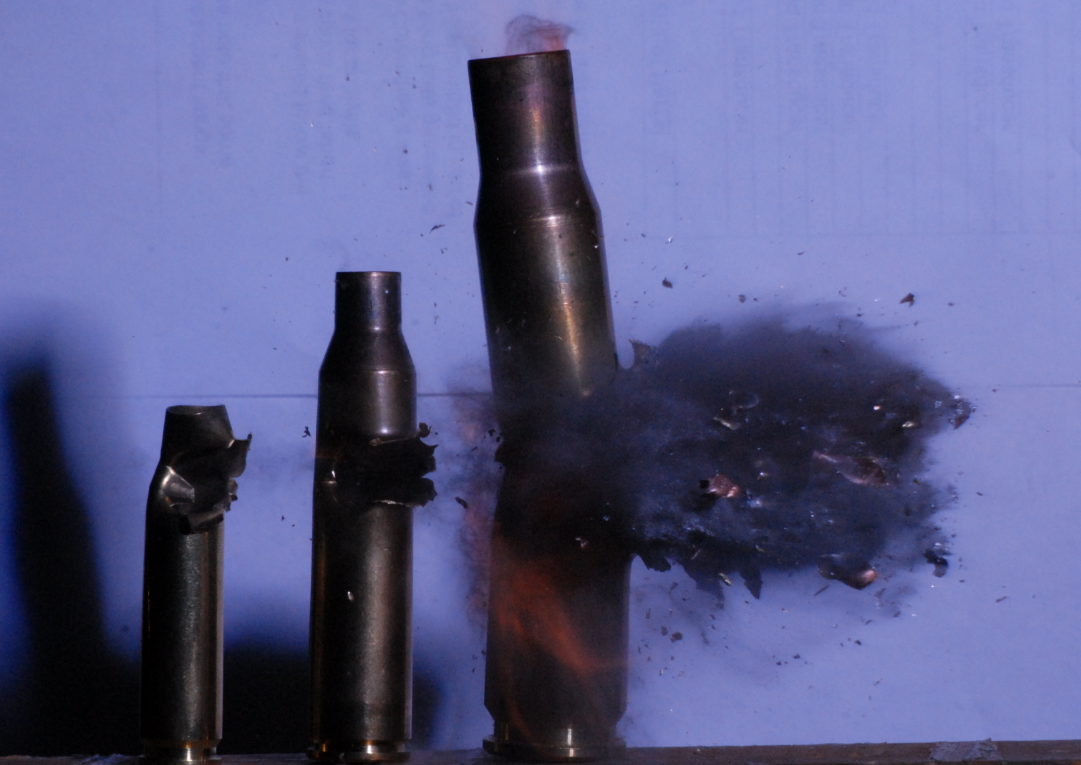

Few questions in handloading are more important, or more difficult to answer honestly, than this one: How do I know this load is safe?
The reality is that the average handloader cannot directly measure or infer chamber pressure. True pressure testing requires specialized test barrels, controlled procedures, reference ammunition and instrumentation such as piezoelectric transducers. These are laboratory tools, not accessible to most people.
That does not mean we are left to guess. It means safety must be established through a disciplined process:
- Begin with current, trustworthy, published load data.
- Cross-reference more than one authoritative source.
- Use the components specified in the data as closely as possible.
- Begin at the published starting load.
- Work upward carefully in the firearm that will use the ammunition.
- Measure velocity with a chronograph.
- Keep complete records.
- Stop before reaching the point where every last foot per second is being pursued.
Most importantly, we must understand what the fired cartridge case can and cannot tell us.
A fired primer or case may reveal that something is wrong. It cannot certify that a load is operating at a safe pressure. By the time certain traditional pressure signs become obvious, the load may already be beyond the pressure for which the cartridge and firearm were designed.
Safe handloading is not the result of finding one magical sign. It is the result of using several layers of reliable information, sound equipment, conservative judgment and repeatable procedures.
Safe Loads Begin With Reliable Data
Every load should begin with data developed by a reputable source under controlled conditions.

Good sources include current manuals and data published by established bullet, powder and reloading-equipment manufacturers. These companies have access to pressure-testing equipment, ballistic laboratories, standardized procedures and trained technicians. Their data is developed through testing rather than observation or speculation.
Examples include published data from Hodgdon, Hornady, Sierra, Speer, Nosler, Lyman, Berger, Barnes, Vihtavuori and other recognized component manufacturers. Some data is printed in traditional manuals, while other manufacturers maintain current online data centers.

A published maximum charge is not a personal challenge or a guaranteed safe charge for every rifle. It is the upper limit produced by that particular combination of components, test equipment, dimensions and laboratory conditions.
The details printed with the charge weights matter. These usually include:
• Cartridge Name
• Bullet manufacturer, weight and construction
• Powder and primer
• Case
• Cartridge overall length
• Test-barrel length and twist
• Starting and maximum charges
• Recorded velocity
• Measured pressure
Looking only at the maximum powder charge while ignoring everything else removes the load from the conditions under which it was tested.
Two bullets of the same caliber and weight are not automatically interchangeable. They may differ in bearing-surface length, jacket material, hardness, internal construction, ogive shape, shank diameter and seating depth. A longer bullet seated to the same overall cartridge length may extend farther into the case and reduce usable powder space. A monolithic copper bullet may behave differently from a conventional cup-and-core bullet of the same weight.
Primers are not necessarily interchangeable either. Changing primer type, brand or lot can affect ignition and pressure, particularly with certain powder and cartridge combinations. Cases from different manufacturers can have different internal capacities. Even different lots from one manufacturer may not be identical.
The closer our components and cartridge dimensions are to the tested combination, the more useful the published data becomes.
Why Cross-Referencing Manuals Matters
A careful handloader should consult more than one reputable source whenever possible.
Cross-referencing does not mean averaging several maximum charges together. It means comparing the complete data sets and attempting to understand why they may differ.
Suppose three trusted manuals list noticeably different maximum charges for what appears to be the same cartridge, bullet weight and powder. That does not necessarily mean one manual is wrong.
The laboratories may have used different:
• Bullet designs
• Cases and case capacities
• Primers
• Cartridge overall lengths
• Test-barrel dimensions
• Throat lengths
• Pressure-testing methods
• Component lots
• Data-development procedures
A powder manufacturer may list data for a generic bullet weight, while a bullet manufacturer may list data developed with a specific bullet. When loading that particular bullet, the bullet manufacturer’s data may provide the closest comparison. The powder manufacturer’s data remains valuable, but the differences should be studied instead of ignored.
Cross-referencing can also reveal transcription errors, outdated information, unusual component combinations or a load that is an outlier among otherwise consistent sources. Even respected publishers occasionally issue corrections. Current editions, official online data and manufacturer safety notices should therefore be checked before beginning a new load.
When reliable manuals disagree, the conservative response is not to select the highest number. Begin with data that most closely matches the actual components being used, and start at the published starting charge. If uncertainty remains, contact the bullet or powder manufacturer.
The Internet Is a Lead, Not a Load Manual
The internet contains an enormous amount of useful reloading information. It also contains unverified loads copied from unknown sources, developed in unknown firearms and repeated so many times that their original context has disappeared.
Statements such as these should never be accepted as proof of safety:
“I have fired it for years.”
“My rifle handles it.”
“The primers still look good”
“There was no sticky bolt”
“Everyone on the forum uses it”
“It is only a little over book maximum”
“This rifle has a strong action”
“I found the load in several online posts.”
A load posted by an unknown person may contain a typing error. The author may have used a different bullet, primer, case, chamber, throat or cartridge length. The load may have been developed in a firearm with more internal volume than yours. It may never have been pressure-tested at all.
There is also no guarantee that the person posting the load understood pressure or accurately identified the components. Online discussions can provide ideas about powders, bullets, applications or performance trends worth investigating. They should direct us toward proper research, not replace published, pressure-tested data.
When an internet load cannot be traced to an authoritative source, it should be treated as an anecdote rather than a recipe.
Every Firearm Is an Individual Pressure System
A cartridge does not develop pressure independently of the firearm. The chamber, throat, bore, action, ammunition dimensions and environmental conditions work together as a system.
Two firearms chambered for the same cartridge can produce different pressure and velocity with identical loads from identical lots. There is a long list of possible differences between firearms, which affect pressure and velocity. Some of these differences are obvious some not.
- Chamber dimensions and headspace
- Throat length and diameter
- Distance from the bullet to the rifling
- Bore and groove dimensions
- Surface finish inside barrel
- Fouling inside the bore
- Suppressor use
A load that appears normal in a generously dimensioned chamber with a long throat may produce substantially different results in a minimum-dimension chamber with a short throat. A bullet that has clearance from the rifling in one rifle may be touching or jammed into the rifling in another.
This is why a load must be worked up again when it is moved to a different firearm, even if both firearms are the same make, model and chambering.
The same caution applies when changing a major component or cartridge dimension. A new bullet, powder lot, primer, case manufacturer, seating depth or brass-preparation method may justify backing down and confirming the load again.
A safe handload belongs to a specific combination of firearm, components, dimensions, lot numbers, conditions and procedures. It should never be treated as universally safe simply because it worked somewhere else.
The Problem With Traditional Pressure Signs

Handloaders have inspected fired cases for generations. This can be useful, but its limitations must be clearly understood.
The Sporting Arms and Ammunition Manufacturers’ Institute, better known as SAAMI, defines pressure estimation as attempting to roughly establish cartridge pressure through visual observation or measurement of a fired case. That wording matters. It is an estimate, not a direct pressure measurement. It may be better worded as
Case and primer signs may warn of a mechanical problem, improper fit, weak brass, excessive headspace or seriously excessive pressure. Their absence does not prove that the load is within the correct pressure limit.
One of the reasons these pressure signs are unreliable is because different firearm design choices or tolerance stacks can cause differences in how the brass case manifests signed of pressure. These differences may include:
- Firing-pin-hole diameter, fit and shape
- Extractor and ejector geometry
- Action timing in semiautomatic firearms
- Headspace dimension
It is important to note that pressure that is unsafe for the firearm, will not result in any obvious signs of high pressure on the brass case. This is true of older firearms that were developed with Black Powder instead of smokeless powder. 45 Colt and 45-70 Gov are two cartridges where a handloader must pay special attention to the firearm they are loading for to ensure the pressure is safe. These firearms can catastrophically fail without the brass showing any obvious signs of high pressure.
These pressure signs are more useful when compared against known “good loads” if a handloader has factory ammunition, observe what the fired case looks like. Particularly the primer, the handloader spent brass should not appear significantly different.
Flattened primers
Primer flattening is probably the most commonly cited pressure sign and one of the most commonly misinterpreted.

Primer appearance is influenced by primer-cup thickness and hardness, primer brand and type, primer-pocket dimensions, headspace and cartridge fit, firing-pin protrusion, breech-face condition, the radius around the primer pocket, seating and the amount the case moves during firing.
A primer can look relatively flat in a normal load. Another primer with a harder cup may remain rounded at a considerably higher pressure. A cartridge with excess clearance between the case and bolt face can allow the primer to back out and then be reseated as the case stretches rearward, creating a flattened appearance that is not solely a pressure measurement.
Comparing fired primers may help identify a change, particularly when every component and condition remains consistent. It still cannot tell us the actual chamber pressure.
Primer cratering or primer flow
Cratering is the flow of primer-cup metal into the clearance around the firing pin.
Pressure can contribute to cratering, but so can a large firing-pin hole, excessive clearance around the firing pin, firing-pin shape, primer-cup hardness or the design of the bolt.
Some firearms crater primers with ordinary factory ammunition. Another firearm with a tightly fitted firing pin may show very little cratering at a much higher pressure. Primer flow should be investigated, but it cannot be read as a calibrated pressure gauge.
Pierced primers
A pierced primer is a serious event and should never be dismissed. Escaping gas can damage the firing pin, bolt face or other parts of the firearm and may direct hot gas or debris toward the shooter.

Piercing can also be influenced by primer construction, firing-pin shape, excessive firing-pin protrusion or damage to the firing-pin tip. High pressure may be involved, but the primer alone cannot diagnose the complete cause. Shooting should stop until both the ammunition and firearm have been evaluated.
Ejector marks and extractor swipes
Bright ejector marks, brass extrusion into an ejector hole or extractor smearing may indicate that the case was forced hard against the bolt face. These observations deserve immediate attention.
They can also be affected by bolt-face design, ejector geometry, brass hardness, residual chamber pressure during extraction and the timing of a semiautomatic action. Suppressor use may change action timing and extraction behavior without changing the handload itself.

These marks are warnings, not pressure measurements. Waiting for them to appear before stopping a load test is not a responsible development method.
Sticky or heavy bolt lift
Heavy bolt lift is frequently treated as a definite high-pressure sign. It can accompany excessive pressure, but it may also result from a dirty chamber, damaged brass, improper sizing, case-body interference, lug galling or another mechanical issue.
Whatever the cause, a new or unexplained increase in bolt-opening effort is reason to stop. It should not be used as the planned endpoint of load development. If the load is increased until bolt lift becomes difficult, the safe stopping point may already have been passed.
Case-head expansion

Measuring case-head or pressure-ring expansion was once commonly recommended as a way to estimate pressure. In practice, brass hardness, case construction, chamber dimensions, measurement location, instrument technique and the amount of expansion produced during the first firing make the method difficult to interpret reliably.
Measurements may help a knowledgeable handloader monitor brass behavior and consistency. They do not convert an ordinary case into laboratory pressure equipment.
Loose primer pockets, case separation and gas leakage

Loose primer pockets, incipient case-head separation, ruptured cases or gas leakage are not minor signs that a load is approaching maximum. They are failure indicators.

Case-head separation may result from excessive sizing and repeated stretching as well as pressure. Loose pockets may reflect high pressure, soft brass, repeated firings or some combination of factors.
Whatever the cause, a component that has lost its ability to contain pressure safely must be removed from service, and the loading and sizing process must be reviewed.

Work Up the Load. Do Not Jump to It.
The purpose of load development is not merely to locate a published maximum. It is to observe how a particular firearm and component combination behaves as the load is increased from a tested starting point.

Begin with the manual’s starting charge or if it is a max load reduce by 10% to obtain a starting load.
At each step, maintain control over the variables:
- Use one powder and one lot.
- Use one bullet and one lot when practical.
- Use one primer lot
- Use cases of known history and consistent preparation.
- Confirm case length and condition.
- Maintain the intended cartridge overall length.
- Verify powder charges with a dependable scale.
- Keep ammunition organized and clearly labeled.
- Record every change.
- Fire from the same firearm.
- Measure velocity under reasonably consistent conditions.
Charge increments should follow the guidance in the manual and should become increasingly cautious near the upper portion of the data. Large jumps near maximum erase the safety value of working up gradually.
Only one meaningful variable should be changed at a time. If the powder charge, primer, seating depth and case are all changed together, it becomes difficult to determine what caused the result.
If anything appears abnormal, including unexpected velocity, unusual sound or recoil, smoke or gas around the action, difficult extraction, a pierced primer, case damage, a squib or an unexplained change in firearm operation, stop shooting and determine the cause.
Never fire the next round simply to see whether the problem happens again.
A Chronograph Is Nearly Essential Equipment
A chronograph does not measure chamber pressure. This point must be made clearly.
It does, however, measure one of the most valuable results of the internal ballistic event: velocity.

Published load data normally includes both powder charge and velocity from a specified test barrel. Your barrel may be longer or shorter, faster or slower and dimensionally different from the test barrel, so an exact match should not be expected. Nevertheless, chronograph data gives us an objective way to compare actual performance with expectations.
Without a chronograph, a handloader may believe a load is producing 2,900 feet per second when it is actually producing 2,750 or 3,050. In the first situation, more powder might be added unnecessarily. In the second, the load may already be giving an important warning that would be invisible on the target and difficult to identify from the primer.
A chronograph can help reveal:
- Velocity that is unexpectedly high for the charge
- A sudden, disproportionate velocity increase
- Erratic ignition
- Large extreme spreads or standard deviations
- Inconsistent ammunition
- Actual performance gained from each charge increase
- Performance changes caused by temperature or component lots
Velocity alone still cannot certify safe pressure. A normal velocity does not guarantee normal pressure, and an individual shot can produce unusual pressure without an equally dramatic velocity change. Chronograph data must be interpreted alongside published data, component details, firearm behavior and careful inspection.
Still, developing a handloads without measuring velocity leaves out one of the best field tools available to the handloader.
Today, a serviceable chronograph can be purchased for roughly the cost of a few boxes of premium factory rifle ammunition. Considering the cost of a rifle, optic, loading press, dies, brass, bullets, primers and powder, a chronograph is no longer an exotic luxury. For anyone developing performance-oriented handloads, it should be considered nearly essential equipment.
Keep Records Detailed Enough to Reproduce the Load

A load written on a scrap of paper as 44 grains, shot good is not a useful record.
A proper load record should include, at minimum:
- Date loaded and date fired
- Firearm identification
- Cartridge
- Bullet manufacturer, model, weight and lot
- Powder and lot number
- Charge weight
- Primer and lot number
- Case manufacturer and number of firings
- Case preparation and sizing information
- Cartridge overall length
- Base-to-ogive measurement, if used
- Distance from the rifling, if known
- Neck tension or bushing used, when relevant
- Crimp information, when applicable
- Ambient and ammunition temperature, when important
- Suppressor or muzzle device
- Individual shot velocities
- Average velocity, extreme spread and standard deviation
- Group size and shooting distance
- Any unusual case, primer, extraction, recoil or firearm behavior
Good records protect us from relying on memory. They also allow a load to be recreated accurately, compared across component lots and safely reconsidered when something changes.
The load label on the ammunition box should identify the contents well enough that the ammunition can never be confused with another test group. An unlabeled cartridge should not be fired on the assumption that we remember what it contains.
Components Must Be Known, Correct and Serviceable

Handloading components do not all have a simple universal expiration date. Properly stored powder and primers may remain serviceable for decades. Poorly stored or contaminated components may become questionable much sooner.
The more useful questions are:
- Is the component positively identified?
- Is it still in its original labeled container?
- Do I know how it has been stored?
- Has it been exposed to excessive heat or moisture?
- Has it been contaminated?
- Does it show deterioration, corrosion, damage or an abnormal odor?
- Is the lot known and traceable?
- Is the brass still mechanically sound?
Powder should be kept in its original manufacturer’s container. Unknown powder should never be identified by its color, shape, smell or comparison with another powder. Many propellants look similar while having dramatically different burning characteristics.
Never return powder from a measure to a container unless there is absolute certainty about its identity. Never mix powders, even when both containers carry the same product name. Combining lots destroys traceability and makes it difficult to investigate unexpected performance.
Old powder should be inspected according to its manufacturer’s recommendations. Evidence of deterioration may include an unusually sharp acidic odor, reddish or rust-colored dust, changes in appearance, container deterioration or other abnormalities. Questionable powder should not be used in a load.
Primers should remain clean, dry, correctly identified and protected from heat, flame, impact, contamination and oils or solvents. Corroded, damaged, contaminated or unknown primers should not be used.
Bullets should be checked for corrosion, dimensional damage, inconsistent identity or contamination. It is a potential bad day when a .308 cal 150gr gets accidently mix into a a box of bullets that are all .308 cal 130gr.
Brass requires particularly close attention. Cases should be inspected for:
- Neck and shoulder splits
- Body cracks
- Corrosion
- Damaged rims
- Loose primer pockets
- Signs of incipient head separation
- Excessive case growth
- Deformed case heads
- Unknown or mixed histories
Brass is a pressure vessel that is intentionally reused. It is also a consumable component. The cost of replacing questionable brass is insignificant compared with the cost of a damaged rifle or an injured shooter.

When the identity, storage history or condition of a component is uncertain, the conservative answer is simple: do not use it.
The Diminishing Return Near Maximum
Many handloaders begin chasing speed because velocity is easy to compare. The difficulty is that the last small increase in velocity may require a disproportionate increase in pressure, stress, recoil, muzzle blast, barrel heat and wear.
Internal ballistics is not perfectly linear. Adding the same increment of powder does not guarantee the same increment of velocity or pressure at every point in the load range. As the practical limits of the cartridge, powder and available case volume are approached, the risk can increase much faster than the useful performance.
This leads to what might be called the 95-percent principle.
It is not a mathematical rule and should not be treated as one. The idea is that a load delivering approximately 95 percent of the maximum practical performance may provide nearly all the useful field capability with a more comfortable operating margin.
Imagine that another powder increase produces only 20 or 30 feet per second. Will that change the outcome on a target, in a match or in the field?
In many cases it will not. At 1,000 yards it may make only a small difference in elevation and wind drift, often less than the effects of changing atmospheric conditions, imperfect range estimation, inconsistent shooting position or ordinary velocity variation.
The small velocity gain may come with:
- Shorter brass life
- Looser primer pockets
- More case stretching – shorter brass life
- Greater temperature sensitivity
- Increased recoil and blast
- Faster throat erosion
- A reduced margin for a hot day or hot chamber
- Greater sensitivity to changes in lots or components
A case rupture or separation in exchange for a gain that cannot be measured on the target is not improved performance.
The best load is rarely the load with the largest number on the chronograph. It is the load that safely produces the required accuracy, velocity, consistency and reliability across the conditions in which it will actually be used.
A slightly slower load that remains stable during summer heat, functions reliably, gives long brass life and repeatedly places bullets where they belong is a better load than one that exists at the edge of the system.
Temperature and Field Conditions Matter

A load developed in cool weather should not automatically be assumed to have the same operating margin in a hot chamber under summer conditions.
Propellants differ in temperature sensitivity. Ammunition left in direct sunlight, on a vehicle dashboard or in a hot chamber can reach a much higher temperature than the surrounding air. Chamber and barrel temperature, fouling, moisture and suppressor use may also affect the complete system.
This does not mean ammunition should be deliberately heated to an unsafe temperature as a home experiment. It means field loads should be developed conservatively, tested under reasonable anticipated conditions and kept out of unnecessary heat.
A load intended for hunting or competition must possess enough margin to tolerate ordinary variations in weather, ammunition temperature, component lots and firearm condition. If a load is safe only when every condition is perfect, it is not a practical field load.
So, How Do I Know a Handload Is Safe?
We cannot prove pressure safety by looking at a primer. We cannot prove it because a bolt opened normally, because a group was accurate or because the same load worked in someone else’s rifle.
Instead, we build confidence through a chain of evidence:
- The load is based on current data from an authoritative source.
- More than one reliable source has been reviewed.
- The actual components and cartridge dimensions match the tested data as closely as practical.
- The firearm and components have been inspected and are serviceable.
- Development began at the published starting load.
- Charge increases followed the manual’s guidance and became more cautious near the upper range.
- Only one significant variable was changed at a time.
- Velocity was measured and compared with reasonable expectations.
- Detailed records were maintained.
- Unexpected behavior caused testing to stop rather than continue.
- The final load remained below the point where tiny performance gains required unnecessary risk.
- The load was confirmed in the specific firearm and conditions for which it was intended.
- Responsible handloaders remain willing to reconsider a load when components, lots, firearms or conditions change.
That is not uncertainty or lack of confidence. It is an understanding of how the system actually works.
Handloading Is Part of Marksmanship
Confidence in a handload should come from the quality of the process, not from how close it is to the edge.
Reloading can be rewarding, cost-effective and deeply educational. It gives the shooter control over ammunition quality, component selection, consistency and performance. It can keep an older firearm useful, improve the availability of uncommon cartridges and produce ammunition precisely suited to a particular purpose.
However, the greatest benefit may be the discipline it teaches.
A good handloader learns to measure instead of assume, document instead of remember and stop instead of forcing a desired result. The process rewards patience, consistency, mechanical understanding and respect for small details.
Those are the same qualities that make a good marksman.
Handloading should therefore be viewed as more than a way to obtain ammunition or save money. It is a skill just as important as shooting well. When practiced carefully, it strengthens our understanding of the firearm, ammunition and the complete ballistic system.
The goal is not to find out how much pressure a rifle will tolerate. The goal is to produce safe, accurate, reliable ammunition that performs its intended job every time.
The last few feet per second are rarely worth pursuing.


