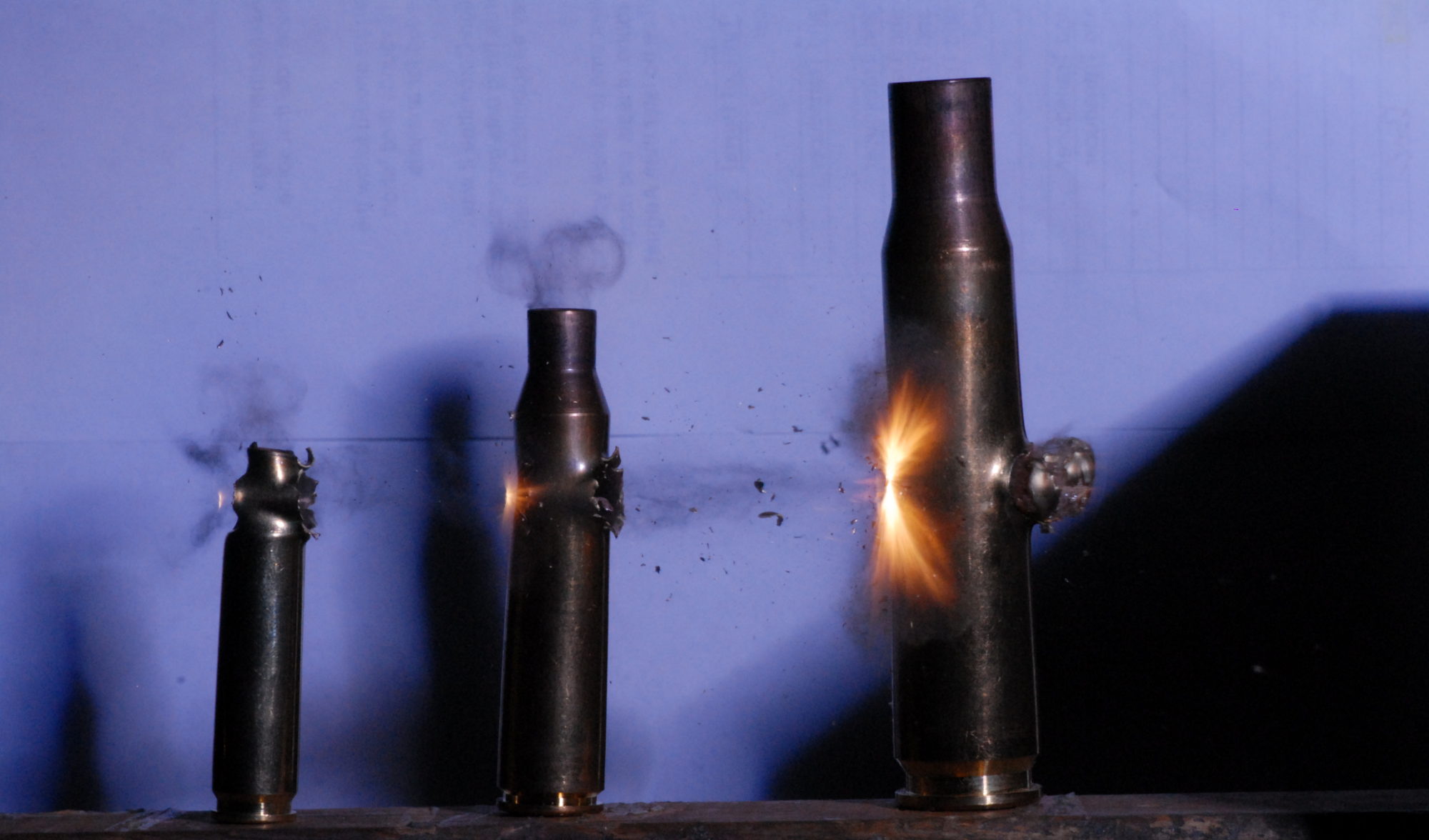
In January 2022, ahead of that year’s SHOT Show, Federal Ammunition introduced the 30 Super Carry. The new cartridge promised something the concealed-carry market had been pursuing for decades: terminal performance approaching the 9x19mm from a smaller-diameter cartridge that could place more ammunition into a compact handgun.

Federal’s advertising distilled the concept into a memorable promise:
“Hits like a 9mm Luger. Carries like a 380 Auto.”
The engineering premise was legitimate. The 30 Super Carry used a .312-inch-class projectile, a narrow rimless case, modern defensive bullets, and unusually high operating pressure to produce substantially more performance than traditional pocket-pistol cartridges. Its smaller diameter also allowed manufacturers to fit two or three additional rounds into magazines of roughly the same dimensions as their 9mm counterparts. Federal’s published comparison placed the cartridge’s muzzle energy close to that of selected 9mm defensive loads and substantially above comparable .380 Auto ammunition.
Smith & Wesson offered the Shield Plus and Shield EZ in the new chambering. Nighthawk Custom chambered premium 1911’s for it. Writers tested it, content creators discussed it, and shooters argued about it with the sort of calm restraint for which caliber debates are universally known.
Four years later, the excitement has largely disappeared. Federal continues to manufacture 30 Super Carry ammunition, and a small number of firearms remain available, but the cartridge has not established itself as a major defensive-handgun chambering.
Avidity Arms later added a 30 Super Carry version of its PD10 and continues to offer a conversion kit, but broader firearm development has stalled.
So what went wrong?
The answer may not be that Federal created the wrong cartridge. The larger mistake was allowing the 30 Super Carry to be judged primarily as an alternative to the 9x19mm while launching it in firearms that did little to demonstrate its advantages over the .380 ACP and .32 ACP.
Federal may have developed the right cartridge and put it in the wrong guns.
Why the 9mm Is So Difficult to Displace?
The 9x19mm is more than a popular handgun cartridge. It is an entire industrial ecosystem.

The U.S. military selected the Beretta M9 in 1985 to replace aging inventories of .45 1911 pistols and .38 Special revolvers. That decision placed the United States alongside its NATO allies in using the 9x19mm as a standard service-pistol cartridge. In January 2017, the Army selected SIG Sauer’s M17 and M18 Modular Handgun System to replace the M9. The pistol changed, but the cartridge did not.

During the M9’s more than three decades of service, generations of American servicemembers trained with the 9mm and carried it during overseas deployments and combat operations. That familiarity played an important, if difficult to quantify, role in changing American attitudes toward the cartridge. Military adoption does not guarantee civilian success, but it provides credibility, visibility, production capacity, and a large population of shooters already familiar with both the firearm and its ammunition.
American law enforcement followed a more complicated path. Agencies moved among the 9mm, 10mm Auto, .40 S&W, and .357 SIG as ammunition manufacturers and law-enforcement organizations attempted to balance penetration, expansion, recoil, capacity, and shooter performance. Improvements in defensive bullet design eventually allowed properly selected 9mm ammunition to meet accepted performance requirements without the reduced capacity and greater recoil associated with larger cartridges.

At the same time, the civilian concealed-carry market was expanding.
The 2004 expiration of the federal assault-weapons ban restored the national civilian market for newly manufactured magazines holding more than ten rounds, although some states retained separate capacity restrictions. Over the following decade, the continued movement toward shall-issue licensing and permitless carry brought millions of new consumers into the defensive-handgun market.
Together, those changes fundamentally altered the firearm landscape. Capacity became a meaningful selling point, and the market increasingly favored pistols that offered more ammunition without imposing excessive size or recoil. Arguments favoring larger calibers remained, but they lost much of their influence as improvements in projectile design allowed the 9x19mm to deliver acceptable terminal performance while offering greater capacity and easier shooter control.
Manufacturers responded with smaller pistols that held more ammunition than the single-stack designs they replaced. Today, micro-compact 9mm pistols commonly provide double-digit capacity in packages that would once have held only six or seven rounds.

The 9mm therefore entered the 2020’s with nearly every commercial advantage a handgun cartridge could possess:
• More than a century of development
• Military and law-enforcement credibility
• Broad firearm support
• Mature defensive projectiles
• Enormous manufacturing volume
• Low practice-ammunition costs
• Availability from nearly every ammunition retailer
• Double-digit capacity in remarkably small pistols
A new cartridge attempting to replace the 9mm would need to offer a dramatic improvement. A modest improvement would not be enough because consumers were not merely choosing between two cartridges. They were choosing between an unfamiliar product and one of the most heavily supported firearm-and-ammunition systems in the world.
That was not the fight the 30 Super Carry needed.
Service Cartridges and Pocket-Pistol Cartridges
The 9x19mm developed into a military and police service cartridge. Its dimensions and performance reflect the demands of a full-size fighting pistol, even though manufacturers have since adapted it remarkably well to compact and micro-compact handguns.
The .32 ACP and .380 ACP developed around a different set of priorities.

John Moses Browning’s .32-caliber blowback pistol entered production through Fabrique Nationale in 1899. The cartridge was narrow, operated at relatively modest pressure, and worked well in simple blowback-operated pistols. It appeared in everything from true pocket guns to police pistols and compact military arms.

The .380 ACP followed several years later and used the same nominal .355-inch bullet diameter as the 9x19mm, but from a shorter case at substantially lower pressure and velocity. It offered more bullet weight and generally greater muzzle energy than the .32 ACP while retaining the ability to function in small, easily concealed pistols.

Neither cartridge succeeded because it outperformed the service cartridges of its era. They succeeded because they allowed manufacturers to build guns that were substantially easier to carry.
That distinction matters.

A shooter who purchases a pocket-sized .380 ACP is knowingly accepting less power than a 9mm in exchange for reduced size, weight, and carrying burden. The value is not found entirely in the ammunition. It is found in the firearm that the ammunition makes possible.
The continued success of pistols such as the Ruger LCP Max demonstrates that the market still accepts that tradeoff. The LCP Max offers a standard 10+1 capacity in a .380 Auto pistol only slightly more than five inches long and roughly ten ounces in weight. It is not popular because shooters believe the .380 ACP surpasses the 9mm. It is popular because the gun can go places that many larger pistols cannot.

The .32 ACP and .380 ACP therefore occupy a different category from the 9mm. The 9mm is the dominant service and general-purpose defensive cartridge. The smaller cartridges survive because they support firearms optimized around concealability.
The 30 Super Carry had the potential to bridge those categories.
A Modern Reinvention of the .32-Caliber Pocket Pistol
The 30 Super Carry is not a lengthened .32 ACP, nor is the .32 ACP its official parent cartridge. Federal describes the 30 Super Carry as a clean-sheet design created specifically for personal defense.
Conceptually, however, it can be understood as a modern, magnum-class reinvention of the .32-caliber pocket-pistol idea.

The 30 Super Carry uses a maximum bullet diameter of .313 inch and a rimless case approximately .344 inch in diameter at the base. Its case is .827 inch long, while overall cartridge length begins at approximately 1.100 inches. Unlike the semi-rimmed .32 ACP, the 30 Super Carry was designed as a modern rimless cartridge better suited to contemporary magazine and feeding systems.
The most striking difference is pressure.

SAAMI standardized the 30 Super Carry at a maximum average pressure of 52,000 psi. Its standardized velocity figures include a 100-grain bullet at 1,250 feet per second and a 115-grain bullet at 1,150 feet per second. By comparison, standard-pressure 9mm Luger has a maximum average pressure of 35,000 psi, while the .32 ACP operates at only 20,500 psi.
Federal used that pressure to drive a relatively small projectile fast enough to approach the muzzle energy and terminal performance of selected modern 9mm defensive loads. Its 100-grain HST load is advertised at 1,250 feet per second and 347 foot-pounds of muzzle energy. Federal’s published comparisons also show a substantial advantage over its selected .380 Auto defensive load.

The 30 Super Carry therefore offered something neither the .32 ACP nor .380 ACP could provide: a narrow cartridge capable of producing performance much closer to the dominant service-pistol round.
On paper, the equation worked.
A smaller case diameter meant greater magazine capacity or a narrower grip. High pressure and modern projectiles addressed the traditional performance limitations of small-caliber pocket-pistol cartridges. The concept was not merely “more rounds than 9mm.” It was the possibility of achieving substantially greater performance than .380 ACP from a firearm built around similarly compact dimensions.
That firearm never arrived.
The Promise and the Platform Did Not Match
Federal’s marketing did not completely ignore the .380 ACP. The company advertised greater capacity than 9mm, greater effectiveness than .380 Auto, and the potential for cartridge-specific frames that were narrower and shorter than comparable 9mm pistols.

The problem was that the firearms offered at launch did not demonstrate that promise.
Smith & Wesson did not design a new pistol around the dimensions of the 30 Super Carry. It adapted its existing Shield Plus and Shield EZ platforms. The Shield EZ gained two rounds over its 9mm counterpart, while the Shield Plus gained three. Nighthawk Custom took a similar approach by chambering existing 1911 designs for the new cartridge.

Those decisions were commercially rational. Adapting an existing firearm reduced development time, tooling costs, testing requirements, and financial risk. It also ensured that actual pistols would be available when the ammunition reached the market.
But the strategy created a category problem.
The consumer encountered the 30 Super Carry primarily in pistols that looked, felt, carried, and concealed much like their 9mm counterparts. The guns were not substantially narrower. They were not substantially lighter. They were not meaningfully easier to conceal. The visible benefit was largely limited to two or three additional rounds.
Federal had promised a cartridge that carried like a .380, but the launch guns largely carried like the 9mm pistols from which they were adapted.
That forced the cartridge into the least favorable possible comparison.
The prospective customer was not deciding whether to replace a seven-round .380 pocket pistol with a ten- or twelve-round pistol offering substantially greater ballistic performance. The customer was being asked to replace an established 9mm pistol with nearly the same pistol chambered for a more expensive and less widely available cartridge.
The question became:
Are two or three additional rounds worth abandoning the 9mm?
For most consumers, the answer was no.
The better question would have been:
Why accept .380 ACP performance when a similarly compact pistol could offer something much closer to 9mm?
That was a far more compelling proposition, but the launch platforms could not demonstrate it.

Avidity Arms later added a 30 Super Carry version of its PD10. The 30 Super Carry model holds 12+1 rounds compared with 10+1 in 9mm, but the PD10 remains a midsized pistol with a four-inch barrel, a 6.94-inch overall length, and a one-inch maximum width. It demonstrates the cartridge’s capacity advantage but still does not address the pocket-pistol opportunity.
The cartridge needed a gun that could prove why its narrower dimensions mattered. Instead, nearly every firearm offered for it reinforced the idea that the 30 Super Carry was merely an alternative chambering for a 9mm-sized pistol.
The Cost of Being Different
The firearm was only the first expense.
A new handgun cartridge requires practice ammunition, defensive ammunition, magazines, and dependable local or online availability. Those costs continue long after the firearm leaves the gun counter.

In the retail sample assembled for this article, brass-cased full-metal-jacket 30 Super Carry ammunition cost approximately $0.44 per round, compared with approximately $0.28 per round for comparable 9mm ammunition. Exact prices change with brand, retailer, package size, shipping, and temporary sales, but the broader pattern remains consistent: 30 Super Carry ammunition generally costs more and is offered by fewer manufacturers and retailers.
The economy of scale enjoyed by the 9mm is extraordinarily difficult to overcome. It is manufactured in enormous quantities, sold in large bulk packages, and frequently discounted. Nearly every gun shop, sporting-goods store, and commercial range that stocks centerfire pistol ammunition carries it.
Price matters because a defensive pistol is not supposed to be purchased, loaded once, and forgotten in a nightstand. Proficiency requires practice.
At a difference of $0.16 per round, 500 rounds of annual practice adds $80 to the ownership cost. At 1,000 rounds, the difference reaches $160.
The firearm is purchased once. The ammunition premium is paid every time the owner visits the range.
That continuing cost might have been easier to justify if the 30 Super Carry enabled a firearm that was substantially smaller, more comfortable to carry, or easier for shooters with smaller hands to control. In an adapted 9mm-sized pistol, however, the customer absorbed nearly all the disadvantages of adopting a new cartridge while receiving only part of its potential benefit.
The ask was too large, while the perceived payoff was too small.
Unfortunate Timing
The 30 Super Carry also entered the market at an awkward moment.

The 2022 SHOT Show was the first in-person show following the virtual 2021 event. NSSF reported more than 43,000 registered attendees and more than 2,400 exhibiting companies. Several major firearm manufacturers were absent, however, and the show still carried the unmistakable aftereffects of the pandemic.
As an attendee, I remember reduced crowds and conspicuous empty booth spaces that would normally have been occupied by some of the industry’s largest manufacturers. From the standpoint of someone attempting to navigate the show floor, it was one of the more pleasant SHOT Shows I have attended. From the standpoint of the industry, it was clear that conditions had not yet returned to normal.

The preceding two years had produced an extraordinary firearm-buying surge. NSSF reported approximately 21 million adjusted background checks associated with firearm sales in 2020 and another 18.5 million in 2021. That figure declined to approximately 16.4 million in 2022. The market remained historically strong, but the direction had changed.
Consumers had already purchased millions of defensive firearms during the previous two years. By early 2022, the urgency that had driven much of that demand was beginning to ease. Buyers were also confronting higher prices across the economy and returning to forms of travel, entertainment, and service spending that had been restricted during 2020 and 2021.
Launching a new cartridge during a rapidly expanding market is difficult. Launching one as an extraordinary buying surge begins to cool is considerably harder.
Federal was asking consumers who had recently purchased 9mm defensive pistols to return to the gun counter, buy another firearm, and begin stocking a new type of ammunition. In exchange, the launch pistols offered only a small increase in capacity.
The 30 Super Carry did not enter a dead market. It entered a market that had become more cautious at precisely the moment when the cartridge needed consumers to experiment.
Timing did not kill the cartridge by itself, but it gave Federal very little room for error.
The Gun the 30 Super Carry Needed
What would a firearm designed specifically around the 30 Super Carry look like?
It should not be another pistol that begins as a 9mm and receives a smaller hole through the barrel. The design should begin with the cartridge’s case diameter, pressure, recoil characteristics, magazine geometry, and intended customer.
The goal would be a pistol positioned between the smallest .380 pocket guns and the current generation of micro-compact 9mm pistols.
A practical design brief might include:
• A locked-breech operating system tuned specifically for 30 Super Carry
• A barrel around three inches long
• A standard capacity of at least 10+1
• A grip circumference meaningfully smaller than comparable 9mm pistols
• A grip long enough to provide useful control rather than merely achieving the smallest possible dimensions
• Improved trigger reach for shooters with smaller hands
• Enough mass in the frame to reduce the sharpness associated with very light pocket pistols
• Usable sights and a trigger intended for actual practice rather than emergency use at conversational distance
• An overall envelope substantially smaller than a Shield Plus or SIG P365
• Likely a ported muzzle to help control muzzle flip
The magazine could potentially use a narrow, slightly staggered arrangement rather than a conventional single-stack or full double-stack geometry. That might allow ten or more rounds without producing the grip width associated with a micro-compact 9mm. The final design would need to balance capacity against feeding reliability, magazine insertion force, slide friction, and grip dimensions.
The pistol should also avoid becoming excessively light. Polymer frames make compact firearms affordable and easy to carry, but extremely low mass increases perceived recoil and makes small pistols difficult to shoot well. An aluminum frame, internal steel chassis, weighted backstrap, or other method of placing mass low in the grip could make the gun more controllable without turning it into a burdensome carry piece.

The cartridge’s pressure might make porting or a compact compensator effective at reducing muzzle rise. That benefit would need to be tested against increased blast, flash, and the possibility of firing from retention or other unconventional defensive positions. Porting should be an option supported by testing, not a decorative pair of holes added because the marketing department discovered slow-motion video.
The firearm would not need to replace every 9mm. It would need to provide a compelling alternative for people who currently select a .380 because the alternative 9mm pistols options are too large.
That is a market with an identifiable problem.
Is It Dead, Jim?
Developing a new cartridge requires substantial engineering, testing, tooling, manufacturing capacity, and marketing support. It is no small undertaking, even for a company with Federal’s resources.
The premise behind the 30 Super Carry remains technically sound. The cartridge provides more capacity than the 9mm in magazines of comparable dimensions, while its pressure, velocity, and modern projectiles produce performance far beyond traditional .32 ACP and .380 ACP loads.
The ammunition accomplished much of what Federal intended.
The commercial system around it did not.
The 30 Super Carry was introduced in firearms that demonstrated its capacity advantage but not its potential advantages in grip circumference, overall width, concealability, or shooter ergonomics. That left it competing directly against the 9mm, a cartridge that was cheaper, more widely available, supported by far more firearms, and already trusted by the customers Federal needed to persuade.
Despite its lack of broad adoption, the cartridge is not completely dead. Federal continues to manufacture ammunition, and Avidity Arms continues to support the 30 Super Carry PD10 and its conversion kit. That is enough to keep the cartridge commercially alive, although hardly enough to call it healthy.
Despite its lack of broad adoption, the cartridge is not completely dead. Federal continues to manufacture ammunition, and Avidity Arms continues to support the 30 Super Carry PD10 and its conversion kit. That is enough to keep the cartridge commercially alive, although hardly enough to call it healthy.
Still, I am prepared to be surprised.
The 9x19mm is more than a century old. It was adopted by the Imperial German Navy in 1904 and the German Army in 1908. It would be remarkable if a cartridge developed during that era happened to represent the final possible balance of size, power, capacity, recoil, and terminal performance for all time. There should still be room for a modern defensive cartridge to improve that equation.

A purpose-built firearm could still change the conversation. It would need to offer more than another two rounds in an existing 9mm platform. It would need to establish a distinct category: a pistol with the concealability and ergonomics traditionally associated with the .380 ACP, but with substantially greater ballistic performance.
The 30 Super Carry did not fail because the engineering premise was foolish. It failed because the firearms offered with it demonstrated only part of the cartridge’s potential.
Federal promised performance near 9mm and concealability near .380 ACP.
The ammunition delivered much of the first promise. The launch platforms never delivered the second.
The cartridge is not quite dead. It is still waiting for the gun it should have had in 2022.
-Jay-


