
Burn rate charts are useful tools for identifying powders that may be worth evaluating for a given load. However, nearly every burn rate chart ever published carries a disclaimer along the lines of: “Do not use for establishing charge weights.” That raises an obvious question. If you can’t use a burn rate chart to set charges, what good is it during load development?
A burn rate chart provides relative burn speed. It shows how powders compare to one another, not an absolute ranking. The actual burn behavior of a powder can vary based on lot variation, cartridge geometry, bullet weight, seating depth, and the pressure regime in which it is used. There is no single universal test that can rank powders across all applications. As a result, burn rate charts are inherently comparative. A powder may behave slightly faster than another in one cartridge and slightly slower in a different one.
This relative nature is exactly what makes a burn rate chart useful.

The way this chart is intended to be used is by identifying the fastest and slowest powders for which published load data exists for a given cartridge and bullet combination. For example, a load developer consulting a Western Powders data sheet might find published data for LT-30 on the fast end and Accurate 2495 on the slow end. Once those bounds are identified, a burn rate window can be drawn across the chart. Any powders falling within that window become candidates for further research and potential testing, regardless of manufacturer.
That window can also be expanded slightly, one powder faster and one powder slower, to explore edge cases. This can be useful when components are scarce or when looking for performance just outside the typical range.
From there, the developer can evaluate each candidate powder individually by consulting published load manuals. When published data does not exist, internal ballistics software such as QuickLOAD can be used to estimate a conservative starting charge. In some cases, the powder in question may not exist in QuickLOAD’s database at all, requiring additional judgment.
A burn rate chart can provide context in those situations, but it must be used conservatively. For example, if the fastest powder in the window has a published starting charge of 23.0 grains, and the unknown powder appears to be slightly slower, that same 23.0-grain charge may represent a reasonable starting point. If the powders appear very close in burn rate, reducing that charge by approximately 10 percent is a prudent approach to ensure a safe margin.
A burn rate chart should never be the only tool used during load development.
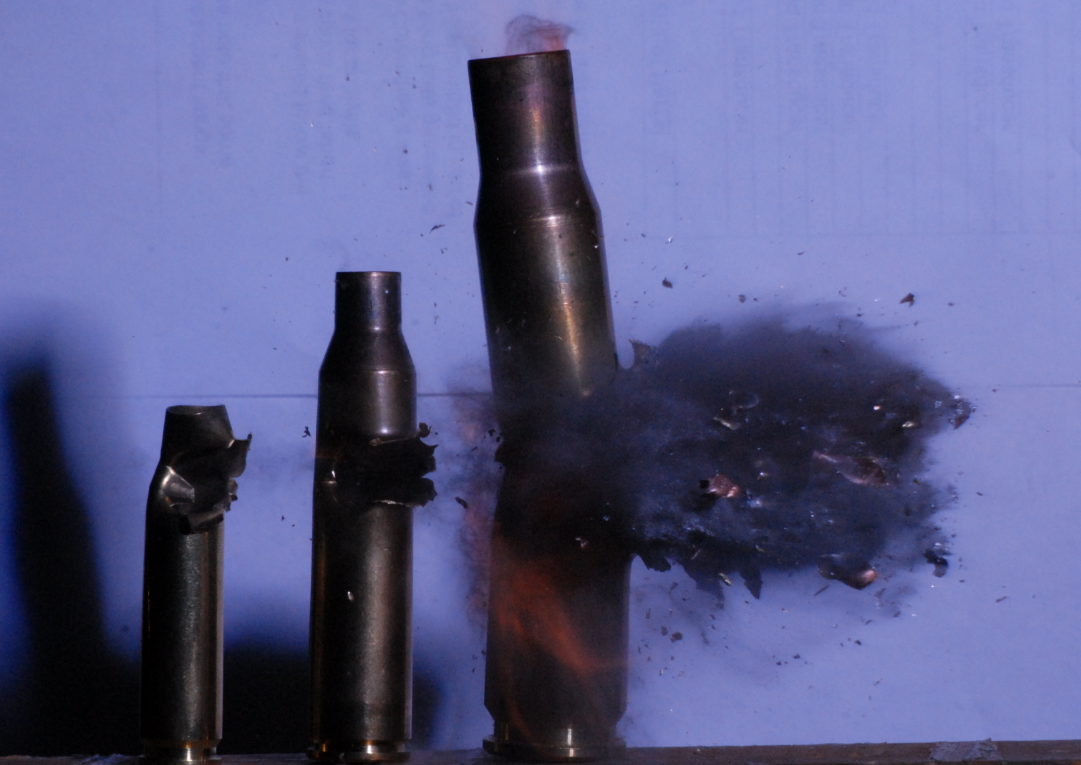
I learned that lesson the expensive way. I once destroyed a $700 test barrel, a $3,000 pressure transducer, and neatly embossed a cartridge headstamp into the face of a hardened steel receiver. No one was injured, but my ego took a beating. The root cause was simple: I misread the chart and confused WC 680 with WC 860. Those two powders are not remotely interchangeable.
Used correctly, burn rate charts are powerful planning tools. Used carelessly, they are an efficient way to turn money into scrap metal.
Now that you understand how to use one properly, you can view our burn rate chart at the link below:
-Jay-


Revised 2/6/2026
