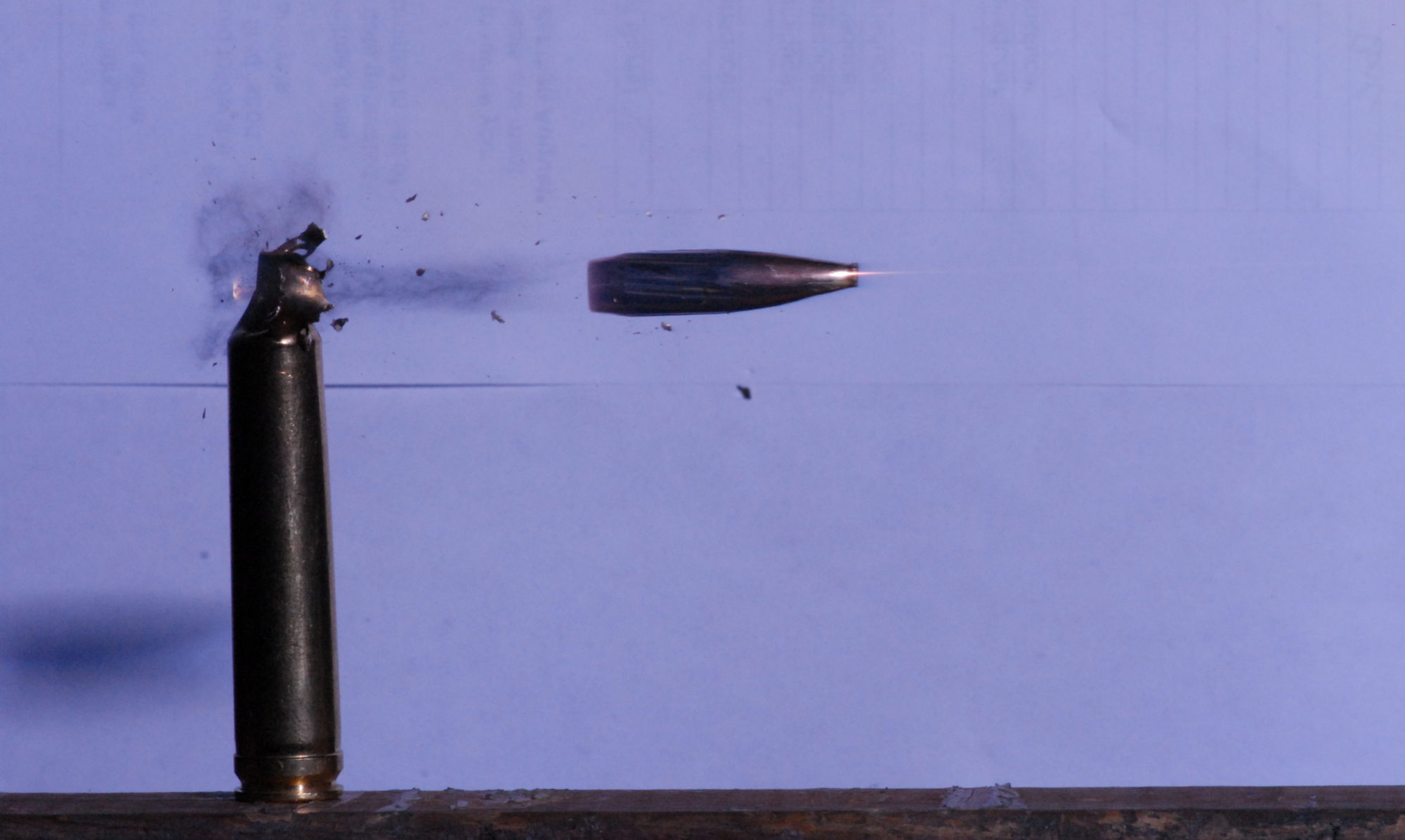
The field of ballistics can be divided into the following three areas of study: Internal Ballistics, External Ballistics, and Terminal Ballistics. There is considerable overlap between the three areas and developing a good load requires an individual to understand something about each. Let’s take a moment to review each area of study.
Internal Ballistics

Internal Ballistics deal with everything that happens from the chamber to the end of the barrel. Things like powder, bullets, brass and primers all are crucial variables that affect the performance of the cartridge and can impact other areas. This area also includes the characteristics of the firearm. Things like chamber dimensions, rifling, twist rates, suppressors and barrel harmonics all may be included in the internal ballistic field of study and directly impact the external ballistics of the bullet.
There are many, many variables that can impact internal ballistics. However there is usually two primary outputs that are of primary concern to the ballistician. What is the maximum internal pressure (P) generated? What velocity (V) does the bullet leave the barrel at?
There may be other variables that are important, such as what is the pressure generated at the gas port in a gas driven firearm? How does the P/V change when the ammunition is subjected to temperature changes, such as being left on a dashboard on a hot Arizona day, or being left in the trunk through an Alaskan winter?
When someone becomes a reloader or a handloader they are taking it upon themselves to understand something about the internal ballistics of a cartridge. This is what this website is primarily dedicated to studying.
External Ballistics

External Ballistics is the study of a projectile in flight. This might be a bullet, a sabot, or a missile. All of these projectiles have are impacted by two primary forces, gravity and drag. The internal ballistics imparts the speed and the spin of the projectile, but once the projectile has left the barrel, whatever has been imparted to the projectile has a bearing on the trajectory, which is the primary output of External Ballistics.
There are several variables that are of primary concern to the external ballistician. Projectile Drag (Expressed as Cd or Bc), atmospheric conditions, velocity, wind, projectile spin, and the projectile weight, to name a few.
Anyone who takes hunting or shooting seriously studies external ballistics. In the field hunters try and predict the trajectory of the bullet prior to taking the shot. Predicting this trajectory correctly is the difference between grounding that prized mule deer or taking nothing home. Mainstream manufacturers publish the Ballistic Coefficient (B.C) values, and the trajectory of the round in order to help those in the field make those predictions.
As distances increases, the number of significant variables increase. Things such as spin drift and the coriolis effect which have little effect on trajectory at ranges under 600 yards, start having a larger effect. If you are a long range shooter, you must be a student of external ballistics.
Tools such as the doppler radar has change the game when it comes to measuring the external ballistic performance of the projectile. The bullet is actually tracked through the air in real time measuring the velocity and distance. The changes in velocity over time allow ballisticians to calculate a Coefficient of Drag, which intern is translated to a Ballistic Coefficient. This technology allows engineers to make minute changes to the bullet and see the effects down range.
Terminal Ballistics

Terminal Ballistics is what happens when the projectile comes to the end of its journey. That might be in the side of an earthen berm or through the fleshy center of a deer. The projectile has a duty to perform, and terminal ballistics is the field that tries to optimize the amount of energy that is transferred from the projectile to the target.
In the last 20 to 30 years there has been large strides forward in defensive handgun and rifle ammunition. Some of this innovation can be traced back to the 1986 FBI Miami Shootout. In the aftermath of this shooting the FBI studied what the contributing factors that lead to the deaths of 2 agents and the wounding of five others. One of the factors identified was the lack of “stopping power”.
Focus was placed on improving bullet technology to offer better barrier penetration while maintaining lethality. Companies, in pursuit of government contracts, began developing bullets that would score the highest on the FBI Ammunition Protocol. These included things like shooting bullets into ballistics gelatin with different barriers ranging from a car windshield to a denim jacket.
The FBI initially went with a 10mm to improve “Stopping Power” but with the improvement of terminal ballistics, many law enforcement agencies including the FBI have gone back to the 9mm due to its low recoil, high magazine capacity, and comparable terminal ballistic to other pistol calibers.
Improvement to terminal ballistics has not been confined to handgun ammunition. Rifle ammunition has also improve considerably. Bullets such as the Barnes TTSX, offers monolithic construction, excellent penetration, and reliably expand even after going through bone or sinew.
When developing a load, knowing what the end goal is, will determine bullet selection. If it’s just target shooting, a full metal jacket or ball type ammunition is typically appropriate, however if there is a requirement for limited penetration, or needing to make an ethical kill on a deer, then it pays to understand and study up on terminal ballistics.