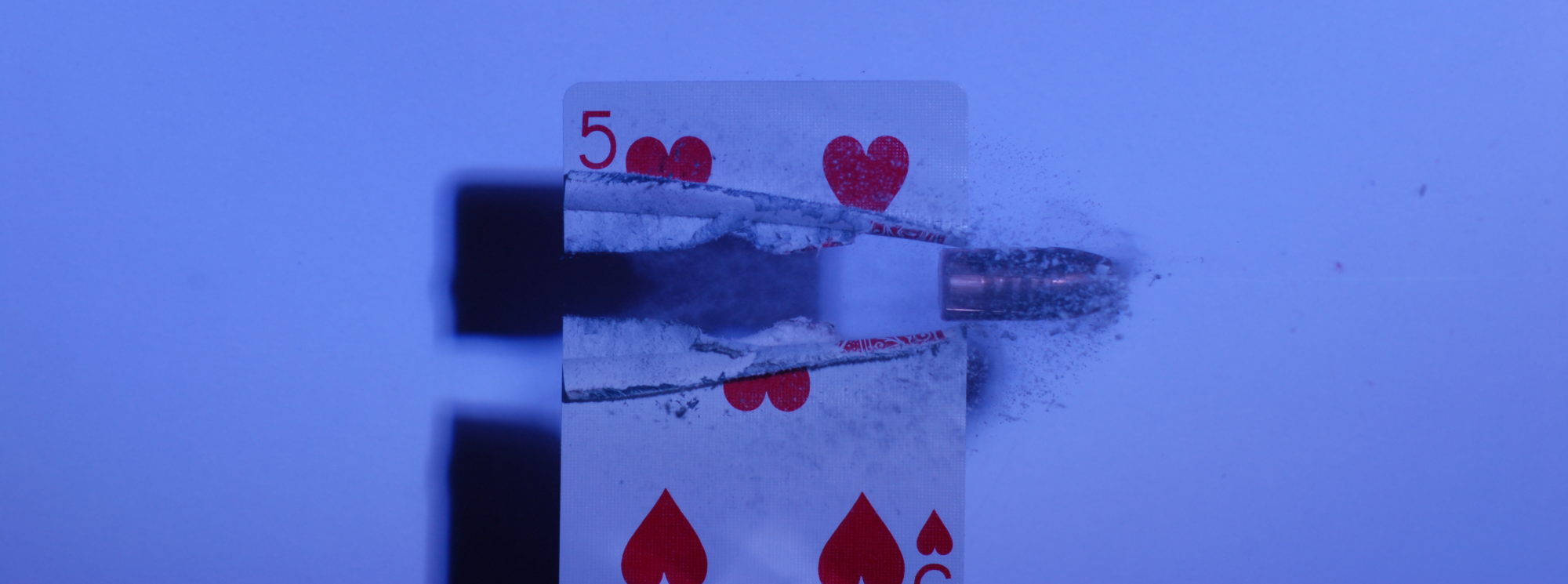

Imagine having a subsonic round with muzzle energy comparable to a .44 Magnum, delivered from an AR platform and capable of being suppressed with many 9mm-rated suppressors. That is what the .338 Spectre delivers.
Often described as being derived from the 10mm Magnum (Not Auto) case, the .338 Spectre is dimensionally closer to a shortened 6.8 SPC-class rifle case necked to accept .338-caliber bullets. The result is a potent and versatile cartridge suitable for AR-15 and bolt-action platforms alike.
The .338 Spectre is a wildcat cartridge with no published SAAMI specifications, and at the time of this writing, no corresponding standards appear in C.I.P. documentation. This effectively limits commercial availability in European markets. The cartridge is supported by Southern Ballistic Research (SBR) but was originally conceived by Teppo Jutsu.
History

It is not difficult to understand the perceived need that ultimately led to cartridges like the .338 Spectre. The AR-15 and M16 entered service in the late 1950s with a cartridge markedly smaller than the .30-caliber rounds that had dominated U.S. military use since the late nineteenth century. The high-velocity 5.56mm projectile fielded during the Vietnam War represented a doctrinal shift, but one that arrived with well-documented growing pains.
Early 5.56mm projectiles exhibited terminal effects that relied on yaw and fragmentation rather than mass alone. When destabilized upon impact, bullets could yaw violently, deviate from straight-line penetration, and create significant temporary cavitation. These effects were influenced by the original 1:12 twist rate, which was optimized for 55-grain bullets but offered limited stability margins under adverse conditions.

In practice, these mechanisms did not always produce consistent incapacitation, and complaints from the field followed. Ammunition was revised with heavier projectiles, increased from 55 to 62 grains, and fitted with mild steel penetrators to improve performance against intermediate barriers. Rifling twist rates evolved accordingly, progressing from 1:12 to 1:7 to stabilize the newer projectiles.
Despite these improvements, criticism persists on modern battlefields. Shorter barrel lengths, commonly 14.5 inches or less, combined with heavier bullets, reduce muzzle velocity by 200 fps or more compared to the original 20-inch configuration, diminishing terminal performance.
This context frames repeated efforts to develop cartridges better suited to modern combat realities. While no universal replacement for the 5.56×45mm NATO has emerged, specialized units have adopted alternative cartridges tailored to specific roles. (For a deeper discussion of this evolution, see our 6.8×51mm cartridge deep dive)
One such example is the .300 Blackout, introduced in the late 2000s by Advanced Armament Corporation. Closely related to the earlier .300 Whisper, the .300 Blackout was standardized by SAAMI in 2011, enabling widespread commercial adoption. Although subsonic loads produced energy comparable to .45 ACP, military use centered on supersonic 110-grain Barnes TAC-TX loads, which offered improved terminal performance from short barrels.

The .338 Spectre emerged during this same period, pursuing a similar goal: maximizing AR-15 versatility while delivering favorable terminal ballistics from compact platforms. Unlike the .300 Blackout, it has never been submitted for SAAMI standardization and remains a proprietary cartridge supported by Southern Ballistic Research.
While often described as a modern development, the .338 Spectre follows a familiar pattern. Its conceptual lineage parallels earlier designs such as the .338 Whisper developed by SSK Firearms (Formerly known as SSK Industries) in the early 1990s. Although not interchangeable, both cartridges reflect long-standing interest in heavy, subsonic .338-caliber projectiles.

SSK Firearms later expanded its Whisper lineage with the introduction of the .338 Whisper II, a straight-wall cartridge based on the .221 Fireball case and designed to accept .338-caliber bullets. The Whisper family as a whole emphasized heavy, subsonic, high–ballistic-coefficient rifle projectiles. At the extreme end of this design philosophy was the .500 Whisper, formed from a shortened .416 Rigby case necked to accept .510-diameter bullets.
Southern Ballistic Research markets the .338 Spectre primarily for close-support roles within military and law enforcement applications, including use as a designated marksman rifle (DMR) or as a primary weapon for tactical teams. In both subsonic and supersonic configurations, the cartridge delivers greater energy than the .300 Blackout. With a 225-grain projectile, barrel length can be reduced by approximately two inches while still exceeding the energy of a 62-grain 5.56mm round fired from a 14.2-inch barrel by roughly 25%. The cartridge can also be suppressed using many common 9mm-caliber suppressors.
Unlike the .300 Blackout, the .338 Spectre requires the use of 6.8 SPC magazines and a compatible bolt face. While these are straightforward modifications to an AR-15 platform, they represent additional components compared to a simple barrel change. From a safety standpoint, the .338 Spectre cannot be chambered or fired in rifles chambered for 5.56×45mm NATO or .300 Blackout, reducing the risk of catastrophic failures caused by accidental cartridge interchange.
I was personally introduced to the .338 Spectre in the summer of 2016 while touring the Southern Ballistic Research facility during a SAAMI training conference. The cartridge immediately stood out as something different from anything I had been loading at the time. After further research, I ordered an AR barrel from SBR a few months later and began working with the cartridge firsthand.
Technical Specs
Southern Ballistic Research (SBR) lists the service pressure of the .338 Spectre at 46,000 psi. As the company that supports the cartridge through both loaded ammunition production and barrel or upper-receiver supply, their published specifications are treated here as authoritative. Some confusion exists, as QuickLOAD lists a maximum pressure of 37,500 psi, a discrepancy that will be addressed later.

Because the .338 Spectre is a proprietary cartridge, chamber, reamer, and cartridge drawings are not publicly available. The verified dimensional and performance data that is available is summarized in the table below.

Load Development Challenges
As with the .300 Blackout, the primary challenge when loading for the .338 Spectre lies in developing reliable subsonic ammunition. The propellant must generate sufficient gas volume to cycle the action while keeping projectile velocity below approximately 1,050 fps. As a result, only a relatively small group of powders tend to perform well for subsonic loads. Many of these will be familiar to .300 Blackout handloaders, including Accurate 1680, CFE BLK, and Shooters World Blackout. Other powders may prove viable, though they have not been personally evaluated here.

When loading subsonic ammunition, velocity becomes the primary limiting factor, rather than pressure. Most subsonic loads fall well below 37,500 psi, as indicated by QuickLOAD modeling. Supersonic loads do not present the same constraints, and many of the powders commonly used in .300 Blackout translate well to the .338 Spectre.

The most significant challenge associated with the .338 Spectre is securing a reliable source of brass. Southern Ballistic Research currently offers purpose-built .338 Spectre brass and remains the sole commercial supplier. This brass features thicker case walls than simply necked-down 10mm Magnum brass, allowing it to better withstand the extraction forces typical of gas-operated AR platforms. Pricing is reasonable, generally falling between $0.43 and $0.46 per case. Given the relatively modest operating pressures of the cartridge, service life should be good when the brass is properly cared for, particularly for subsonic applications.

For those interested in forming their own cases, caution is advised when using 10mm Magnum brass. In testing, the case body has shown a tendency to split, sometimes on the first firing, due to insufficient wall thickness. A better alternative is 6.8 SPC rifle brass, which shares the same case head diameter and is available with either large or small rifle primer pockets. However, because 6.8 SPC brass is designed for a 55,000 psi service pressure, it typically exhibits reduced internal capacity compared to purpose-built .338 Spectre brass.
Forming .338 Spectre brass from 6.8 SPC is not a simple one-step neck-down operation. The process requires trimming, reforming, and neck reaming to achieve a neck wall thickness of approximately 0.012–0.013 inches. Given the additional labor involved, many handloaders ultimately choose to purchase preformed cases directly from Southern Ballistic Research.
Advantages of 338 Spectre
The .338 Spectre may have become a serious contender in a space now firmly occupied by the .300 Blackout had it been introduced earlier and submitted for SAAMI standardization. As it stands today, its advantages over more mainstream cartridges are less obvious. That said, it still earns a place in the gun safe for shooters interested in something different.

The muzzle energy of a 225-grain .338 Spectre load exceeds that of a .44 Magnum, and the use of a streamlined rifle projectile allows that energy to be retained over greater distances. While the .300 Blackout typically achieves higher muzzle velocity, the .338 Spectre benefits from higher ballistic coefficients, resulting in more favorable downrange performance. In fact, the .338 Spectre retains more energy at 1,000 yards than a 115-grain 9mm JHP produces at the muzzle.

Like the .300 Blackout, the .338 Spectre operates within the AR-15 platform, giving it inherent versatility. It also adapts well to compact bolt-action or single-shot rifles, where useful terminal performance can be achieved without excessive barrel length. Shortening a traditional .308 Winchester barrel to achieve similar handling characteristics is possible, but the resulting blast and muzzle flash are rarely appreciated by those nearby.
These same characteristics can make the .338 Spectre attractive for defensive use, offering a compact and maneuverable rifle with greater terminal effectiveness than most pistol-caliber carbines, while avoiding the severe blast associated with short-barreled 5.56×45mm rifles.
Lastly, the .338 Spectre is well suited to cast bullets. As with the .300 Blackout, cast projectiles make excellent subsonic range fodder. While velocities around 1,600 fps approach the practical upper limit for most cast bullets, the cartridge still offers the flexibility to fire subsonic loads delivering nearly twice the muzzle energy of a .45 ACP, or supersonic loads approaching the energy of a 5.56×45mm fired from a 20-inch barrel.
Disadvantages
The .338 Spectre utilizes 6.8 SPC magazines, which are less common than standard 5.56×45mm magazines and typically hold 25 rounds in a magazine sized for 30 rounds of 5.56. Because the .338 Spectre shares the same case head dimensions as the 6.8 SPC, this capacity is achieved without reliability concerns.
Because the .338 Spectre is a proprietary cartridge, shooters are largely limited to a single source for factory brass, loaded ammunition, and component support. Reloading dies are currently offered by Southern Ballistic Research (SBR) and are manufactured by Lee Precision. Earlier die sets were produced by CH/4D, which offered excellent quality but did not include a dedicated crimp die. SBR’s current die offerings address this omission and are well suited for use in gas-operated rifles.

Reliance on a single-source ecosystem always carries risk. If support for a cartridge were to end, owners could find themselves dependent on limited tooling, proprietary specifications, and a shrinking knowledge base. That concern has become more relevant with the introduction of the .338 ARC, which fills a similar role while benefiting from SAAMI standardization and a broader, more conventional supply chain.
Situations like this are not unusual among wildcat and semi-proprietary cartridges. The .338 Spectre remains a viable and capable option, but it occupies a narrow niche and is unlikely to achieve widespread market adoption. The emergence of the .338 ARC does not make the Spectre obsolete, but it does change the long-term outlook. For most shooters, the ability to purchase factory ammunition and components through normal retail channels will ultimately favor the .338 ARC, and over time it is likely to displace the .338 Spectre in the broader market.
Other Information
300 Cast Bullet for 338 Spectre

I collaborated with several .338 Spectre shooters to help design a 300-grain bullet mold specifically for the cartridge through NOE Bullet Moulds. NOE allows customers to submit custom designs provided there is sufficient interest to justify a production run. The resulting bullet was designed without traditional lube grooves and is intended for either powder coating or epoxy coating. While I would have preferred the inclusion of conventional lube grooves, the final design reflected the preferences of the broader group. For those not set up to coat bullets, lighter alternatives with traditional lube grooves are available, albeit at reduced projectile weights.
Bolt Action Barrels
At present, Southern Ballistic Research does not list a Remington 700 barrel option on its website. However, they are accommodating to custom requests, and a bolt-action barrel can be produced if desired. In my view, the .338 Spectre would make an excellent bolt-action cartridge, particularly for a compact, field-oriented rifle where useful terminal performance can be achieved without excessive barrel length.
Similar Wildcats

The 338 Razorback, which has sometimes been refered to as the 338-10mm Nanosonic, is a is a 10mm Auto necked down to 338 Cal which can be loaded with 250 or 300-grain bullets. Same concept as the 338 Spectre, launch a 250 to 300 grain bullet at 1000fps.
Lehigh Defense publishes load data for the .338 Lehigh, a wildcat cartridge based on the 7.62×39 case, with 6.5 Grendel brass also serving as a suitable parent case. Information on the .338 Lehigh is limited, and Lehigh does not provide extensive documentation beyond basic load data. Additionally, QuickLOAD does not include Lehigh’s 103-grain Close Quarters bullet in its database. However, it does list a comparable 105-grain Light Weight High Velocity (LWHV) projectile produced by Impala Bullets.
Light Weight Bullets in 338 Spectre
Prior to encountering this entry in the QuickLOAD database, I was unfamiliar with Impala Bullets. The company is based in New Zealand, and available information suggests this particular projectile may no longer be in production. The bullet appears to be of solid metal construction, which limits its practical relevance here. As a result, it is best treated as a modeling proxy rather than a viable component option.
For the purpose of running a “what-if” analysis, the QuickLOAD model provides a reasonable estimate of potential performance when pairing lightweight .338-caliber projectiles with the .338 Spectre. In these simulations, peak pressure was capped at 35,000 psi before generating a propellant comparison table. Under those constraints, Winchester 296 and Lil’Gun ranked highest, with predicted velocities approaching 2,400 fps.

Lehigh Defense publishes ballistic coefficient values for its bullets, allowing for reasonable downrange performance estimates. At subsonic velocities, the high ballistic coefficient of a 300-grain projectile allows it to retain velocity significantly better than lighter, faster bullets. While the 103-grain Close Quarters-style projectile achieves substantially higher muzzle velocity, its lower mass results in less retained energy than a 225-grain load. That higher velocity does, however, increase the likelihood of fragmentation when passing through intermediate barriers such as drywall or wood, potentially reducing the risk of over-penetration.

One projectile of particular interest is Lehigh Defense’s 232-grain Subsonic Brass Solid, which is designed to expand between approximately 700 and 1,200 fps. Although lighter than a 300-grain SMK-style projectile, its solid construction results in increased length, reduced case capacity, and lower sectional density. Even so, it may represent a compelling subsonic hunting option for the .338 Spectre.

At elevations around 5,150 feet above sea level, this projectile should remain within its expansion window out to extended distances. While this is not an endorsement of extreme-range subsonic hunting, the ballistic behavior is nevertheless interesting from a technical standpoint. For those curious about trajectory, predicted drop at 1,000 yards is approximately 186 MOA, or roughly three degrees of elevation. This is significantly less than that of a typical 9mm or .22 LR projectile, though still substantial by any practical measure.

Taken together, the variety of available .338-caliber bullets provides ample opportunity for experimentation. Despite its challenges, the .338 Spectre remains an engaging cartridge for shooters interested in load development and unconventional ballistic problems. For readers curious about novel projectile designs, Lehigh Defense offers several unique options, including their Flash Tip and Xtreme Cavitator bullets, which merit further technical exploration.
Conclusions
I have a soft spot for cartridges that live just outside the mainstream. For me, the .338 Spectre fills that niche. The AR-15 I built around it would generously be described as a “Franken-gun,” assembled from a mix of used and discounted parts. I spent money where it mattered, namely on a solid two-stage trigger and a quality bolt carrier group. The barrel was purchased new from Southern Ballistic Research, while the rest of the rifle wears a standard A2 stock and a well-worn Troy Alpha rail picked up at a discount.
I am far from finished experimenting with the cartridge. There are additional loads I plan to develop and document, and meaningful accuracy and terminal ballistics testing still needs to be done. Even so, what I have seen so far has been enough to keep me interested. The .338 Spectre is unlikely to ever become a mainstream cartridge, and its long-term future depends largely on continued support from SBR.
If that support were to end, I would hope the design specifications would be released publicly so those who have invested time and resources into the cartridge could continue to support it independently. While it would be possible to reverse-engineer a workable chamber design, introducing yet another unofficial specification would only add confusion rather than clarity.
That said, if you have the opportunity to spend time with a .338 Spectre, it is a cartridge worth exploring. And for those inclined to follow along, I expect this article to evolve as additional testing and data become available.
-Jay-


Revised 2/7/2026